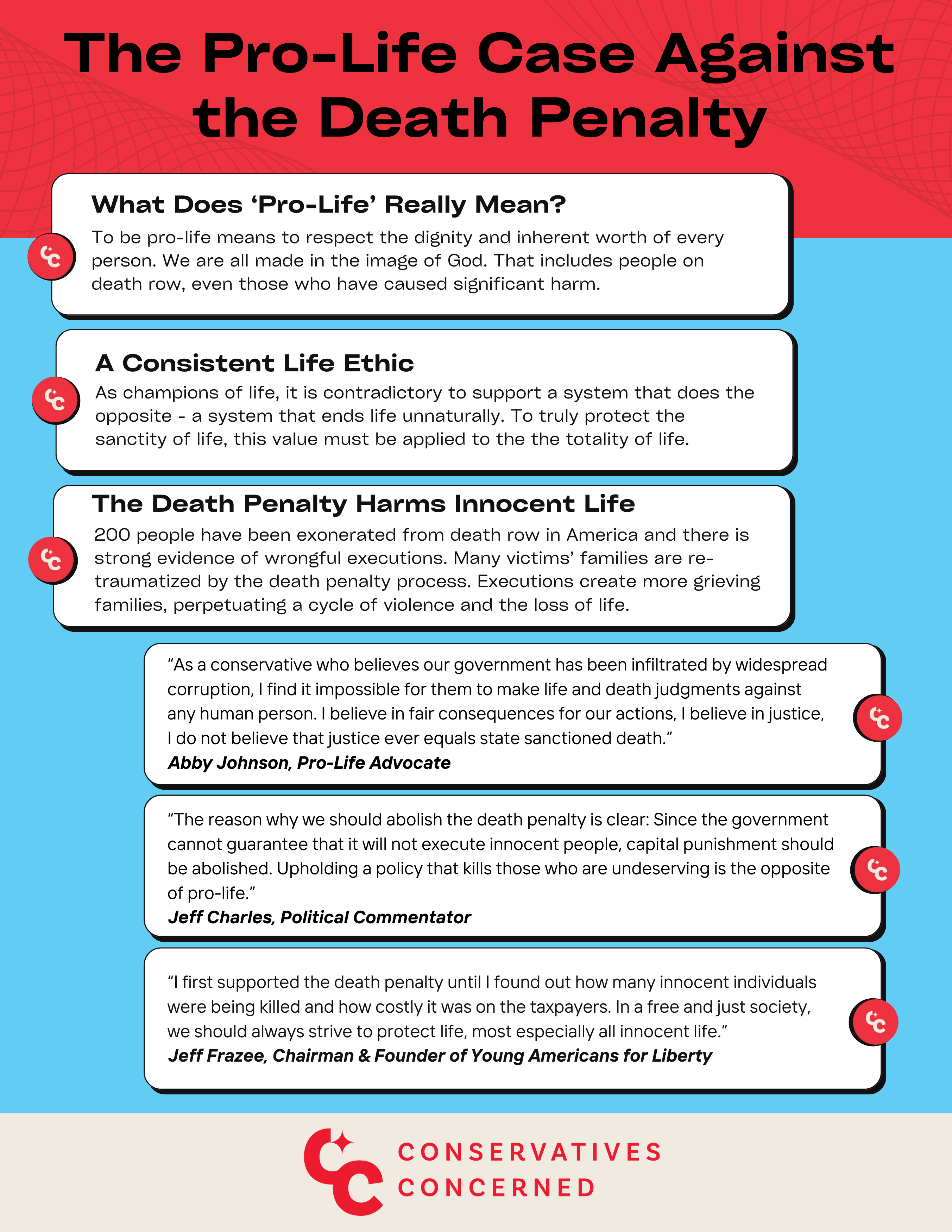
Conservatives have long-championed protecting the sanctity of life. We believe that from the moment of conception, every person is created with inherent value and worth.
As we have examined the death penalty more closely through the years, many conservatives have started asking a difficult question: If human life is sacred, do we reserve the right to deliberately end it for those guilty of heinous crimes?
More and more pro-life conservatives are concluding that the answer is no. For many conservatives, opposition to the death penalty is a natural extension of pro-life principles.
A culture of life should not pick and choose who deserves to live
The pro-life movement is rooted in the belief that human dignity does not come from a person’s age, ability, social status, or circumstances. Human life has value simply because it is human life.
The death penalty instead asks us to decide which lives are beyond redemption and which lives are no longer worthy of protection.
Even those who have committed terrible crimes remain human beings. They can be punished, imprisoned, and held accountable without the state taking their life. Life without parole ensures public safety while preserving respect for the value of human life.
The death penalty harms innocent life
No justice system is perfect because human beings are not perfect.
Over the years, innocent people have been sentenced to death and later exonerated. Advances in DNA testing have exposed serious flaws in eyewitness testimony, forensic evidence, and prosecutorial practices. Every exoneration serves as a reminder that mistakes happen.
For pro-life conservatives, the possibility of executing even one innocent person should give us pause. When a punishment cannot be reversed, there is no way to correct a tragic error.
Executions create more victims
The death penalty is often presented as a way to bring closure, but many victims’ families describe a different experience.
Capital cases can take decades to resolve, forcing families to repeatedly revisit their trauma through appeals, hearings, and media attention. Rather than bringing swift justice, the process often prolongs suffering.
Executions also create new grieving families, leading to the loss of more loss and perpetuating a cycle of violence. The death penalty system traumatizes and retraumatizes victims families, perpetrator’s families, juries, witnesses to executions, other inmates, wardens – anyone that has a hand, willingly or unwilling, in this process.
A truly pro-life approach seeks accountability while reducing unnecessary harm.
The government should not wield the power to take a life
Conservatives are inherently distrustful of the government – and for good reason. We recognize that government institutions are often inefficient, prone to error, and incapable of perfection.
There is no greater government power than the power to decide who lives and who dies.
If we do not trust the government to manage our health care, our businesses, our children’s education, or even our mail without mistakes, we should be cautious about trusting it with the irreversible power of the death penalty.
A consistent life ethic
Being holistically pro-life means more than opposing abortion. It means cultivating a culture that values and protects human life at all stages whenever possible.
We can hold violent offenders accountable. We can protect public safety. We can stand with victims and their families. We can do all of these things without empowering the state to take human life.
CASE STUDY: Pro-Life, Anti-Death Penalty
“As a conservative who believes our government has been infiltrated by widespread corruption, I find it impossible for them to make life and death judgments against any human person. I believe in fair consequences for our actions, I believe in justice, I do not believe that justice ever equals state sanctioned death.” – Abby Johnson, Pro-Life Advocate
“To be truly pro-life is to believe that human dignity is not a reward for good behavior, nor a privilege granted at birth, but an inherent light that no hand of man has the authority to extinguish. If we are to protect life where it is most vulnerable, we must also refuse to destroy it where it is most broken; for a society is defined not by how it judges its worst, but by how deeply it honors the sanctity of existence itself.” – Christal Martin, a family member of a murder victim
Hear what more pro-life advocates have to say about the death penalty.
Additional Resources:
- Kristan Hawkins: Why the Death Penalty is Not Consistent with a Pro-Life Worldview
- The Pro-Life Case Against the Death Penalty
- U.S. Catholic Conference of Bishops: Life Matters: A Catholic Response to the Death Penalty
- Abby Johnson’s Politely Rude: A Pro-Life and Conservative Perspective with Demetrius Minor
- Demetrius Minor: Being Pro-Life Means Being Anti-Death Penalty
- Demetrius Minor: My fellow conservatives, join the fight to against the death penalty
- Texas Observer: Pro-life, Anti-Death penalty